Rack PDU Sizing Guide: Amps, Outlets and Monitoring
How to calculate rack PDU current, choose outlet types and decide between basic, metered and switched PDUs for a data center cabinet.
Calculate the load in kW, then add 20% headroom. A 16 A PDU provides about 3.5 kW; a 32 A PDU about 7 kW. Use one PDU per feed and choose metered or switched models for remote monitoring.
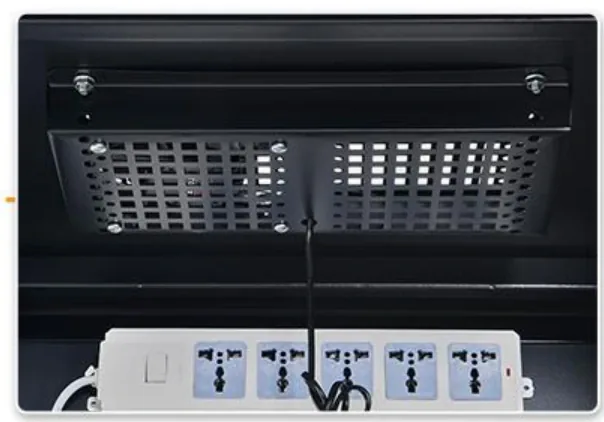
A rack PDU is the last electrical component before the server. It determines how many devices can be connected, how the load is distributed and whether the operations team can see power consumption per rack.
Sizing mistakes usually show up later: a PDU that runs near its breaker limit, outlets that do not match the installed plugs, or no way to measure load during a capacity review.
What is a rack PDU and when do you need one?
A rack PDU distributes one upstream feed to multiple outlets inside a cabinet. It may include a circuit breaker, surge protection, current metering or remote switching.
You need a rack PDU when:
- the cabinet has more devices than the upstream circuit can connect directly
- equipment uses different plug types
- you need per-rack current measurement
- you want a single service point for the cabinet’s power
A PDU does not replace the upstream distribution board or the UPS. It is a cabinet-level distribution layer.
How do you calculate the PDU current rating?
Use the nameplate current, not the power supply rating alone. A server with two 800 W power supplies may draw far less in normal operation, but the nameplate current is the safe starting point for branch design.
The basic calculation:
- List every device on the PDU.
- Add the nameplate current in amps at the site voltage.
- Apply a diversity factor for devices that do not run at full load simultaneously.
- Keep the continuous load at or below 80% of the breaker rating.
| Input | Breaker | 80% continuous guideline | Typical use |
|---|---|---|---|
| 10 A | 10 A | 8 A | Small network cabinets |
| 16 A | 16 A | 12.8 A | Standard server cabinet |
| 32 A | 32 A | 25.6 A | High-density or dual-feed racks |
The 80% rule is a planning guideline, not a substitute for local electrical code. Confirm the derating requirements with the electrical designer.
For dual-corded servers, split the load across two PDUs on separate feeds. Each PDU should be able to carry the full load if the other feed fails, or the design should accept a reduced load during maintenance.
Which outlet types should you specify?
Match the outlet to the plug on the equipment, not to the country alone. Many servers use IEC C13 and C19 connectors worldwide, while edge devices, switches and test equipment may use local plugs.
| Connector | Typical equipment | Note |
|---|---|---|
| IEC C13 | 1U/2U servers, switches | Most common data center outlet |
| IEC C19 | High-power servers, UPS | Higher current rating |
| Schuko | European edge devices | Local plug type |
| UK BS 1363 | UK/Ireland equipment | Fused plug |
| US NEMA 5-15/5-20 | North American devices | Voltage and plug specific |
| Chinese GB | Domestic equipment | Local standard |
A mixed outlet configuration is common in projects with equipment from several vendors. Specify the count of each type and the position on the strip, so the installation team does not have to rearrange devices later.
Do you need metered or switched PDUs?
The choice depends on how the rack will be operated.
- Basic PDU: no metering. Lowest cost, suitable for small cabinets with known loads.
- Metered PDU: local or remote current display. Useful for capacity planning and detecting overload.
- Metered per outlet: identifies which device is drawing power. Useful in shared or multi-tenant racks.
- Switched PDU: remote on/off per outlet. Useful for remote reboot, but requires a security policy and a reliable management network.
If the site has a DCIM or BMS platform, confirm the protocol (SNMP, Modbus TCP) and the data points it expects. A PDU that cannot be integrated becomes a manual reading task.
How should redundant PDUs be arranged?
For dual-corded equipment, use two PDUs on separate feeds:
- PDU A on feed A, PDU B on feed B
- each PDU sized to carry the full rack load, or the design accepts a reduced load
- cords routed on opposite sides of the cabinet to avoid a single fault
- clearly labeled A/B at both ends
Avoid plugging both server cords into the same PDU. That defeats the redundancy even if the upstream has two feeds.
For single-corded equipment, a transfer switch or a redundant upstream path is needed if availability matters. A PDU cannot create redundancy for a device with one power inlet.
What should the PDU datasheet include?
A useful datasheet states:
| Item | Why it matters |
|---|---|
| Input current and voltage | Matches the upstream circuit |
| Plug type and cable length | Confirms site connection |
| Outlet types and count | Matches equipment |
| Breaker rating | Protects the branch |
| SPD rating | Surge protection level |
| Metering accuracy | Capacity planning |
| Protocol | DCIM/BMS integration |
| Mounting orientation | 1U or 0U |
| Operating temperature | Room conditions |
| Certification | Local compliance |
Ask for a dimensional drawing as well. A vertical PDU that is 50 mm too long will not fit the cabinet, and a horizontal PDU may conflict with a cable manager.
How do you plan PDU capacity for growth?
Leave headroom. A PDU that is loaded to 80% on day one has no room for a new server or a higher-power replacement. A common approach is to plan the rack at 60–70% of the PDU capacity and reserve the rest for growth.
Also plan the outlet count, not just the current. A rack with 12 outlets may be electrically fine but unable to connect a new device without a splitter, which is a poor practice in a data center.
If the project is phased, standardize the PDU model and mounting position across rows. Spare PDUs and cords can then be shared, and the operations team sees the same layout in every cabinet.
For project support, send the rack elevation, equipment list and destination. RackSource will confirm the input, outlet mix and mounting position before production.
Frequently asked questions
05 Q&A How do I calculate the current for a rack PDU?
Should I use one 32 A PDU or two 16 A PDUs?
What is the difference between metered and switched PDUs?
Do PDUs need surge protection?
Can a PDU be mounted vertically in a 600 mm cabinet?
Products related to this article
JZ-PDU Series Rack Power Distribution Unit 1U or 0U power distribution with optional breaker, SPD and metering. View details 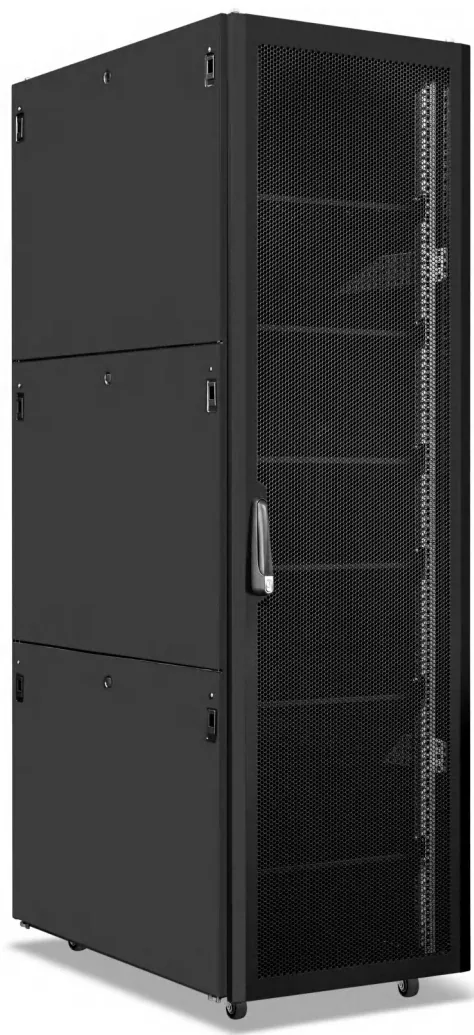 JZ-SC Series 42U Server Cabinet A 1200 mm deep, high-load frame for rack servers and GPU nodes. View details
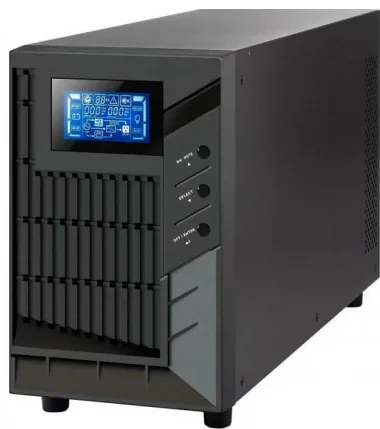 JZ-UPS Series Modular UPS System 50–1200 kVA modular online UPS for centralized power rooms. View details