Rack PDU — 1U and 0U, 16A/32A, C13/C19, Metered and Intelligent
Rack PDUs for cabinet power distribution: 1U horizontal or 0U vertical, 10/16/32 A, C13/C19 outlets and optional metering.
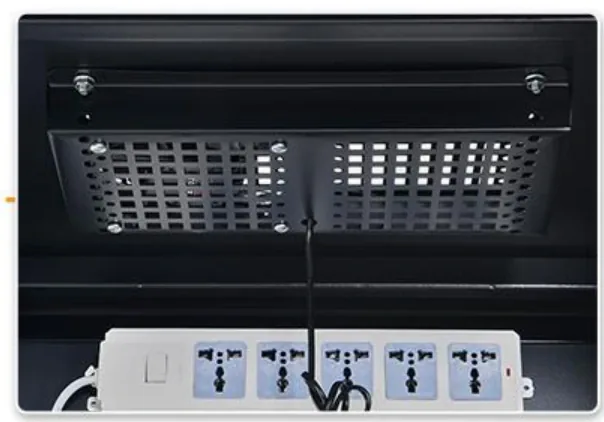
A rack PDU distributes 220–250 V AC power inside a cabinet. A 16 A PDU provides about 3.5 kW; a 32 A PDU provides about 7 kW. Choose 1U horizontal for 6–8 outlets and 0U vertical for 20–30 outlets, and use two PDUs on separate feeds for redundancy.
Last reviewed: 2026-11-07
PDU selection starts from the equipment list: input current, outlet type, outlet count and whether metering or remote switching is required.
For dual-corded servers, use two PDUs on separate feeds. A single PDU cannot create redundancy for a device with one power inlet.
Best for
- Server and network cabinets
- Metered or switched power projects
- Dual-feed racks with C13/C19 equipment
Key specifications
PDU input reference
| Input | Breaker | Continuous guideline | Typical outlets |
|---|---|---|---|
| 10 A | 10 A | ≤8 A | 6–8 |
| 16 A | 16 A | ≤12.8 A | 8–12 |
| 32 A | 32 A | ≤25.6 A | 8–12 high power |
How to choose
List devices and plugs
Record nameplate current and plug type for every device on the PDU.
Calculate current
Add nameplate current, apply diversity and keep continuous load below 80%.
Choose mounting
Use 1U horizontal for shallow racks and 0U vertical to save rack units.
PDU formats and outlet counts
A 1U horizontal PDU mounts in the 19-inch frame and usually has 6 to 8 C13 outlets. A 0U vertical PDU mounts at the rear and can carry 20 to 30 C13 outlets plus 4 to 6 C19 outlets. The vertical format saves rack space and is the standard for dense server cabinets.
Choose the format by outlet count and access. A small network cabinet with four switches may need only 8 outlets; a 42U server cabinet with 20 servers may need 24 to 30 outlets plus C19 for high-power equipment.
Current, power and breaker sizing
At 220–250 V, a 16 A PDU supplies about 3.5 kW and a 32 A PDU supplies about 7 kW. Apply a derating margin and confirm the upstream breaker and cable size. Do not run a PDU continuously at its full rating.
For a cabinet with 6 kW of IT load, two 32 A PDUs on separate feeds are common. For a network cabinet with 1 kW to 2 kW, one 16 A PDU is usually enough. For three-phase power, use a three-phase PDU or three single-phase PDUs on separate phases.
Metering, switching and protection
A basic PDU has a breaker and outlets. A metered PDU adds a local display for current, voltage and power. A monitored PDU adds SNMP or Modbus. A switched PDU adds outlet-level on/off and restart. For colocation and remote sites, switched PDUs reduce site visits.
Protection options include MCB or RCBO breakers, surge protective devices, over-temperature alarms and sequential start. Sequential start avoids the inrush current that can trip the upstream breaker after a power restore.
Installation and cable management
Mount a 1U PDU at the bottom or top of the cabinet and a 0U PDU on the rear side rail. Keep the input cable bend radius clear and the breaker accessible. Label every outlet and cable, and keep power cables away from data cables.
For redundant equipment, connect dual-corded devices to A and B PDUs. Use outlet-level metering to balance the load and identify hot spots. Confirm the plug type and the local electrical code before ordering.
Rack PDU current and power
| Input | Typical power | Outlets | Use |
|---|---|---|---|
| 10 A | About 2.2 kW | 6–8 | Small network cabinet |
| 16 A | About 3.5 kW | 8–12 | Network / low-power rack |
| 32 A | About 7 kW | 20–30 | Server cabinet |
| 3-phase 32 A | About 21 kW | 30–42 | High-density rack |
PDU feature levels
| Level | Metering | Switching | Typical use |
|---|---|---|---|
| Basic | None | None | Small cabinet |
| Metered | Local display | None | Load check |
| Monitored | Remote | None | BMS integration |
| Switched | Remote | Per outlet | Remote restart |
| Switched + metered | Per outlet | Per outlet | Colocation |
PDU selection checklist
| Item | Target | Why |
|---|---|---|
| Input current | Load + 20% | Headroom |
| Voltage | 220–250 V | Local supply |
| Outlet type | C13 / C19 | Equipment |
| Format | 1U / 0U | Space |
| Metering | Local / remote | O&M |
| Redundancy | A/B feeds | Uptime |
Frequently asked questions
08 Q&A Do I need a PDU or a UPS?
What is a zero U PDU?
Can the PDU be customized?
What is the difference between a PDU and a power strip?
How much power can a 32 A PDU handle?
Do I need a metered PDU?
What is a switched PDU used for?
Can a PDU be connected to a UPS?
Related pages
Send us your rack schedule or floor plan
Share cabinet quantities, U heights, power loads and the destination port. Our engineering team will confirm the configuration, drawing and production lead time.
Request a quotation