Server Rack — 19-Inch Floor Standing Racks, 22U to 42U
19-inch server racks in 22U, 38U and 42U, 600/800 mm wide and 1000/1200 mm deep, with mesh doors and PDU mounting.
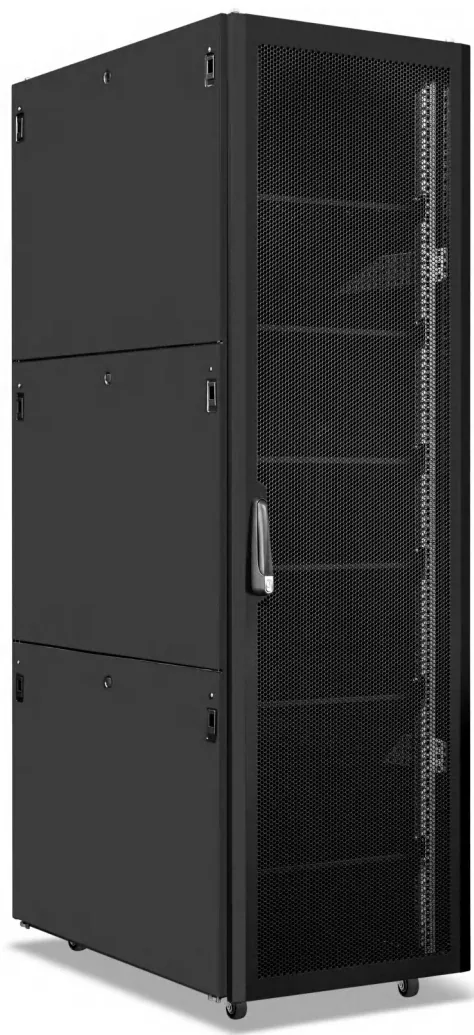
A server rack is a 19-inch frame that holds servers and network equipment in U increments of 44.45 mm. Common heights are 22U, 38U and 42U; common depths are 1,000 mm and 1,200 mm; typical static loads are 800 kg to 1,000 kg for closed cabinets and 300 kg to 600 kg for open frames.
Last reviewed: 2026-11-07
A server rack sets the limits for equipment depth, airflow, cable routing and floor loading. The rack depth must cover the rail kit, the server body, rear cable bend radius and vertical PDU clearance.
The models below use SPCC cold-rolled steel frames, adjustable 19-inch profiles and mesh or perforated doors. Casters, leveling feet, shelves, fan trays and PDUs are selected at order.
Best for
- Data center and server-room rows
- GPU, storage and virtualization clusters
- Projects that need a PDU, fan tray and cable management
Key specifications
Server rack size reference
| U height | Width | Depth | Load class | Typical use |
|---|---|---|---|---|
| 22U | 600 / 800 mm | 1000 mm | About 700 kg | Small server rooms |
| 38U | 600 / 800 mm | 1000 / 1200 mm | About 700–1000 kg | Branch and edge rooms |
| 42U | 600 / 800 mm | 1000 / 1200 mm | About 700–1000 kg | Data center rows |
How to choose
Count the rack units
Add the U height of every device and leave 20–30% for growth.
Fix the depth
Measure the longest rail kit and add at least 100 mm behind the rear rail.
Confirm the load
Check the populated weight, floor loading and whether casters or feet are required.
Server rack sizes and the 19-inch standard
The 19-inch rack standard defines a mounting opening 482.6 mm wide and U positions spaced at 44.45 mm. A 42U rack therefore has 1,866.9 mm of mounting height. The outside width is usually 600 mm or 800 mm, and the depth is chosen by equipment: 1,000 mm for shallow servers, 1,200 mm for deep servers and rear cabling.
Height, width and depth are independent choices. A 42U rack can be 600 mm wide and 1,200 mm deep, or 800 mm wide and 1,000 mm deep. Select the height by the number of devices, the width by side cable management and PDU space, and the depth by the longest server plus cable bend radius.
Open frame vs closed cabinet
An open frame is a bare 19-inch structure with no doors or side panels. It costs less, gives unrestricted airflow and is easy to access. It is used in test labs, staging areas and small telecom rooms where security and dust control are not critical.
A closed cabinet adds doors, side panels, locks and cable entries. It protects equipment from dust and unauthorized access and supports controlled front-to-rear airflow. For production data centers, server rooms and shared facilities, a closed cabinet is the normal choice.
Load, depth and airflow selection
Check the static load rating, the floor loading and the anchor method. A 42U cabinet with 800 kg to 1,000 kg static load is common for servers; open frames are often rated 300 kg to 600 kg. A raised floor needs proper pedestal support and load distribution.
Depth drives both equipment fit and airflow. Leave 100 mm to 150 mm behind the rear mounting profile for cables and PDU. Use mesh or perforated doors with at least 65% open area, blanking panels and a fan tray or row cooling for loads above 6 kW.
Power, cable management and accessories
Most server racks use two PDUs on separate feeds, with C13 and C19 outlets. A 32 A PDU provides about 7 kW; a 16 A PDU provides about 3.5 kW. For redundancy, connect dual-corded servers to both PDUs.
Accessories include vertical cable managers, horizontal managers, shelves, blanking panels, baying kits, castors, leveling feet and brush cable entries. Keep power and data cables separated, and label both ends of every cable.
How to specify a server rack
Start with the equipment list: U height, depth, power and weight. Add 20% spare U for growth and future switches. Choose the depth from the deepest device plus 150 mm for cables. Choose the load rating from the total weight plus 25% margin.
Then select the door type, PDU configuration, cable management and cooling. Confirm the delivery route, the floor type and the anchor method before ordering. A typical project rack ships in 20 to 30 working days after drawing approval.
Server rack size reference
| Height | Mounting space | Typical use |
|---|---|---|
| 22U | 977.9 mm | Small server room |
| 38U | 1,689.1 mm | Medium room |
| 42U | 1,866.9 mm | Data center standard |
| 47U | 2,089.2 mm | High-density room |
Open frame vs closed cabinet
| Item | Open frame | Closed cabinet |
|---|---|---|
| Cost | Lower | Higher |
| Security | None | Lockable |
| Dust control | Low | Good |
| Airflow | Unrestricted | Controlled |
| Typical load | 300–600 kg | 800–1,000 kg |
| Typical use | Lab / staging | Production room |
Server rack selection checklist
| Item | Target | Why |
|---|---|---|
| U height | Equipment + 20% spare | Growth |
| Depth | Longest server + 150 mm | Cables and PDU |
| Width | 600 / 800 mm | Side management |
| Static load | Total weight + 25% | Safety |
| Door open area | ≥65% | Airflow |
| PDU | 2 × 32 A | Redundancy |
Frequently asked questions
09 Q&A What is the most common server rack size?
Is 1000 mm deep enough for modern servers?
Can the rack be shipped assembled?
What is the difference between a server rack and a server cabinet?
What is the standard depth of a server rack?
How much weight can a server rack hold?
How many U do I need for my servers?
Do server racks need cooling?
What is the lead time for a server rack?
Related pages
Send us your rack schedule or floor plan
Share cabinet quantities, U heights, power loads and the destination port. Our engineering team will confirm the configuration, drawing and production lead time.
Request a quotation